An awake newborn does not need to be made sleepy for a good picture. The simplest awake newborn photo ideas use what the baby is already doing: looking toward a window, stretching on their back, gripping a parent's finger or resting in a secure two-arm hold. Work at floor level, support the head and neck, keep the setup free of props, and stop when the baby needs feeding, changing or comfort.
The safety boundary for every idea below
These are documentary prompts, not instructions for specialist newborn posing. The baby is either fully supported by an attentive adult or awake on their back on a clear, firm floor-level play mat. The two tummy-time ideas are for awake, closely supervised tummy time that is already appropriate for your baby.
The American Academy of Pediatrics advises back placement on a firm, flat surface for every sleep and says tummy time should happen only while the baby is awake and supervised. Its current safe-sleep guidance also says to keep pillows, quilts, loose bedding and stuffed toys out of an infant's sleep space. If the baby falls asleep during a picture, end the setup and follow your usual safe-sleep routine.
- No baskets, buckets, hammocks, beanbags or raised surfaces.
- No chin-on-hands, “froggy,” suspended or propped-sitting poses.
- No removing a supporting adult's hands for the sake of the photograph.
- No lights, cameras or phones balanced above the baby.
- No loose wraps, headbands or small props near the face.
For a fuller stop-and-check list, read our newborn photography safety guide. Medical needs differ, especially for premature or medically fragile babies, so use advice from the baby's clinician when it is more specific than a general photo guide.
Eight parent-held awake newborn photos
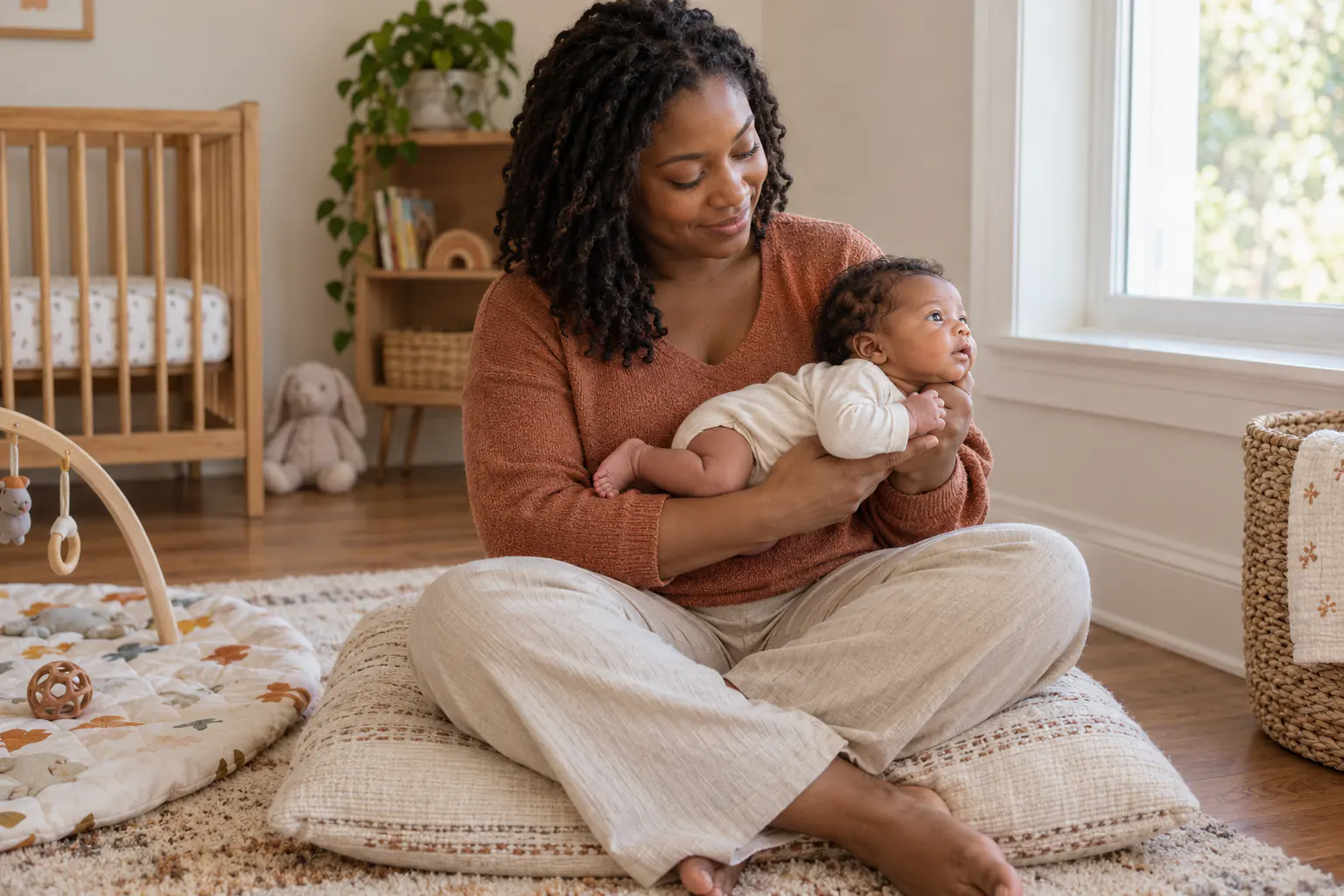
- The window cradle. Have a seated parent cradle the baby across both forearms with the head and neck supported. Turn the parent's body about 45 degrees toward a bright window and photograph the baby's open eyes from slightly above the adult's elbow.
- The shoulder look-back. With the baby upright against an adult's chest and one hand supporting the upper back and neck, photograph over the adult's shoulder. Keep the face turned naturally; do not rotate the baby's head for the camera.
- Face-to-face. A seated parent holds the baby securely at chest height and looks down. Frame both profiles. The space between their noses is often more expressive than a forced smile.
- Two hands, one tiny hand. Keep the secure hold unchanged and crop close to the baby's hand resting across an adult finger. Include enough of the arm to show the connection rather than presenting a floating detail.
- The chest cuddle. Photograph the baby against the parent's chest from the side, with both adult hands visible. This works when the baby is calm but not interested in looking at the camera.
- Eyes toward the voice. Ask a second adult to speak softly beside the camera. Photograph the glance, not a manufactured expression. Stop if the baby turns away or becomes unsettled.
- The after-feed hold. Once feeding and burping are finished, photograph the relaxed, supported hold that already follows. Keep private feeding details out of frame unless the parent wants them documented.
- Parent's-eye view. From the seated parent's perspective, photograph the baby resting across both forearms. A wide frame with knees and hands included makes the support obvious and tells more of the story.
Eight back-lying, floor-level photos
Place a firm play mat on the floor in soft indirect light. The baby stays on their back and an adult stays within reach. Remove arches, hanging toys and loose blankets if they block your shooting position or encourage you to leave the baby's side.
- Offset eye contact. Kneel beside the mat and photograph from a slight diagonal, keeping the phone over the clear floor beside the baby rather than directly above the face. Hold it with both hands; a wrist strap adds protection but does not replace a firm grip.
- The full-body stretch. Step back enough to include the entire body as the baby stretches naturally. Do not straighten limbs or tuck hands into place.
- Hands beside the cheeks. Wait for both hands to wander near the face on their own, then take the frame. The slightly uneven placement is what makes it believable.
- The yawn sequence. Use Live Photos or a short Burst and keep the beginning, middle and end of one yawn. Three frames together show more personality than a single “perfect” mouth shape.
- Window-side profile. Stay at floor level and photograph across the mat as the baby looks toward a window. The baby remains on their back; only the camera position changes.
- Fingers and feet in one frame. From the end of the mat, wait for a natural curl that brings hands and feet into view. Do not press the knees or fold the body into a pose.
- The wide nursery frame. Include the clear floor area, window and seated parent nearby. The newborn will look small in the room, which is exactly the scale families forget.
- One minute of expressions. Keep the same composition and photograph the frown, stare, blink, almost-smile and stretch without intervening. Choose the frame that looks most like this particular baby.
Two supervised tummy-time photos
Use tummy time only while the baby is awake and an adult is close enough to intervene immediately. Follow the baby's clinician's advice if there are feeding, breathing, muscle-tone or developmental concerns. The goal is to document a normal supervised moment, not to hold the head in a photogenic position.
- The side-level glance. Put the camera at mat level, off to the side, while the supervising adult remains just outside or partly inside the frame. Photograph a brief natural head turn. End the attempt at the first sign of distress.
- The effort, not the milestone. A forehead resting for a moment, elbows moving and eyes searching are part of tummy time too. You do not need a dramatic head lift to make the picture meaningful.
Two family frames that keep support visible
- Sibling beside, parent holding. Seat the older child next to a parent who holds the newborn securely. The sibling can look, talk or touch a covered foot with permission. Do not ask a young child to hold the newborn for the shot.
- Three generations of hands. The parent keeps the ordinary two-arm hold while a grandparent rests a hand on the parent's shoulder or lightly touches the baby's covered leg. Frame the connection without transferring the baby between people repeatedly.
How do you photograph bright eyes without overstimulating?
Use the room the baby is already comfortable in. Turn off television screens, silence notification sounds and keep the session to a few minutes. A bright window should be beside the baby, not direct sun in their eyes. One adult can talk quietly from near the camera; several adults clapping and calling from different directions usually produces confusion rather than eye contact.
Set the phone before you bring it up. Clean the lens, switch off distracting filters, choose Photo mode and tap the nearer eye to focus. Live Photos are useful for small changes in expression. Our complete guide to newborn photos with an iPhone covers exposure and framing, while how to make a baby smile for photos explains why age and timing matter more than tricks.
What should you do when the baby will not look at the camera?
Take the picture anyway. Newborn vision and attention are still developing, and direct eye contact is only one kind of portrait. A look toward a parent, a slow blink or an alert stare beyond the frame may feel more honest than a front-facing shot.
If the baby is rooting, hiccupping, grimacing, arching, turning away or beginning to cry, put the phone down and meet the need. You can try again another day. The photo is never the urgent part.
From a simple awake photo to a styled portrait
A clear parent-held or back-lying photo can also be a source for an AI-styled portrait. That lets the physical session remain ordinary while the background, lighting and wardrobe become creative later. Generated imagery can still alter a face, hand or body detail, so it is not a substitute for reviewing the result.

Keep the real setup simple
Totti offers more than 50 studio, milestone and seasonal templates for iPhone. Start with one clear, fully supported photo, compare the generated portrait with the original, and export in HD at 2048×2560. The app is free to download with optional in-app purchases.
Get Totti on the App StoreIf a generated scene suggests that the newborn was physically placed in a basket, propped upright or otherwise posed, label it as AI-styled when sharing. Do not recreate that apparent setup at home.
The best awake newborn picture is not the one with the most elaborate pose. It is the one that preserves a real look while every support point remains visible and ordinary.