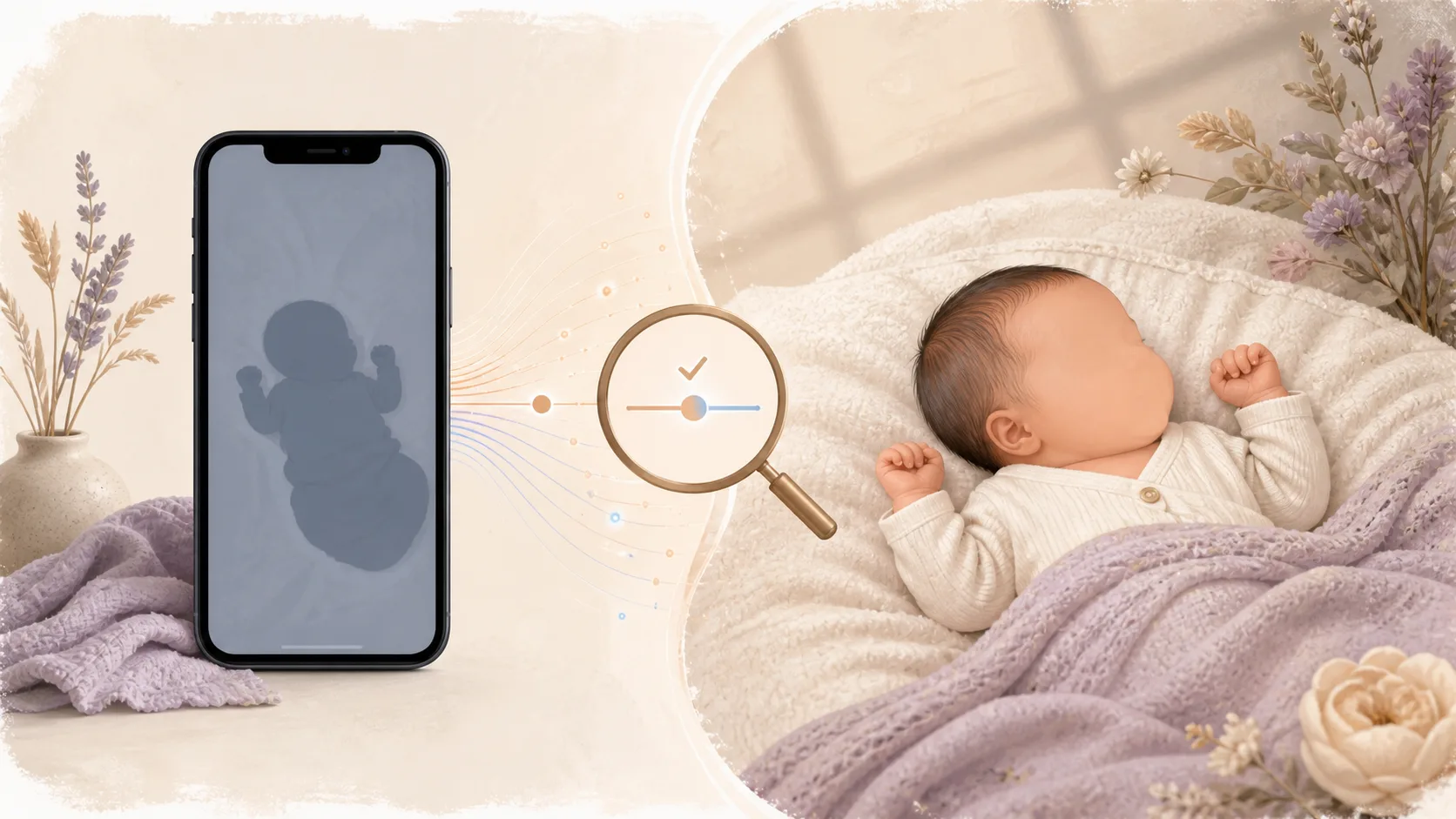
What if you took the picture first and built the studio afterwards? AI newborn photography runs in exactly that order. The ordinary phone picture comes first, and the styled scene gets built around it after the fact. You upload one clear snapshot of your baby, choose a template, and the app regenerates the background, lighting, outfit and styling while aiming to keep your baby recognizable.
An AI newborn photoshoot is therefore different from a future-baby generator: it starts with a real child rather than inventing one. A good result should still look unmistakably like the source, but generation is not infallible. Compare the face, hands and small details with the original before saving or sharing. The rest of this guide covers how the process works, what it can and cannot do, and how to try it with Totti.
Current Totti facts, checked for this guide
I build Totti, so this guide separates product facts I can verify from general claims about AI photography. For the September 4, 2026 update, I checked the public App Store listing and the current product flow shown below. Totti version 1.0.2 is listed for iPhone with iOS 17 or later, is free to download with optional in-app purchases, and presents a catalog of 50+ templates. The generation itself can vary from photo to photo; that is why recognizability is a review goal rather than a guarantee.
| Verified product fact | Where to check it |
|---|---|
| Designed for iPhone; iOS 17+ | Current App Store listing |
| Free download with optional in-app purchases | Price and In-App Purchases labels on the listing |
| Source-versus-result comparison before export | The in-app before-and-after screen pictured in this guide |
| AI can change small visual details | Check each generated face, hand, edge and light direction against the source |
What is AI newborn photography?
It is a photo transformation based on a real newborn image, not an invented picture of a hypothetical baby. That distinction matters because “AI baby” tools cover several unrelated jobs. Face-mixer novelty apps imagine a future child. Normal photo editors adjust exposure and color. AI newborn photography starts from a real baby snapshot and generates a styled scene around it.
| Tool or service | Starts with | Main result |
|---|---|---|
| Future-baby generator | Parent photos or prompts | An imagined face that does not document a real newborn |
| Traditional photo editor | An existing baby photo | Crop, exposure, color and small pixel-level adjustments |
| AI newborn photoshoot | One existing baby photo | A generated backdrop, outfit, lighting and portrait style around the source |
| Photography studio | The baby at an in-person session | Photographed sets, lighting, posing and professional retouching |
Totti fits the third row. It begins with a real photo and offers 50+ templates across Classic, Cozy and Outdoor looks, milestone cards and seasonal collections. The built-in before-and-after control exists for a reason: the finished portrait should be checked against the source, not accepted blindly.
You end up with the kind of portrait you'd normally book a studio for, whether that's a curled newborn on a knit blanket, a "Hello World" milestone card or a classic plain-backdrop pose. In a real studio those curled and propped looks are the demanding ones. Newborn safety guidelines for photographers are clear that a baby is never left unsupported for them, and that the most dramatic versions are composited from two frames where an adult's hands were holding the baby the whole time. If you've been comparing that route against what a newborn photoshoot costs in 2026, this is the third option most parents don't know exists.
How does an AI newborn photoshoot work, step by step?
- Upload one snapshot. A clear, well-lit phone photo with your baby's face visible. A nap-time picture by a window is perfect. You don't need a posed shot; a simple back-lying photo gives the AI plenty to work with.
- Pick a template. Totti has 50+ scenes across Classic, Cozy and Outdoor categories, plus seasonal collections (Christmas, Halloween, Easter). Newborn-specific templates include the Potato Sack Pose, Curled Taco Pose and Sweet Slumber.
- Choose the styling. Virtual outfits (cozy knits, floral rompers, holiday wear, studio attire) are matched to each scene, and there's a boy/girl setting for the finished look.
- The AI restyles the scene. The background, lighting, wardrobe and props are regenerated to match the template, with the goal of retaining a recognizable baby from the source. Inspect the output closely; generation quality can vary.
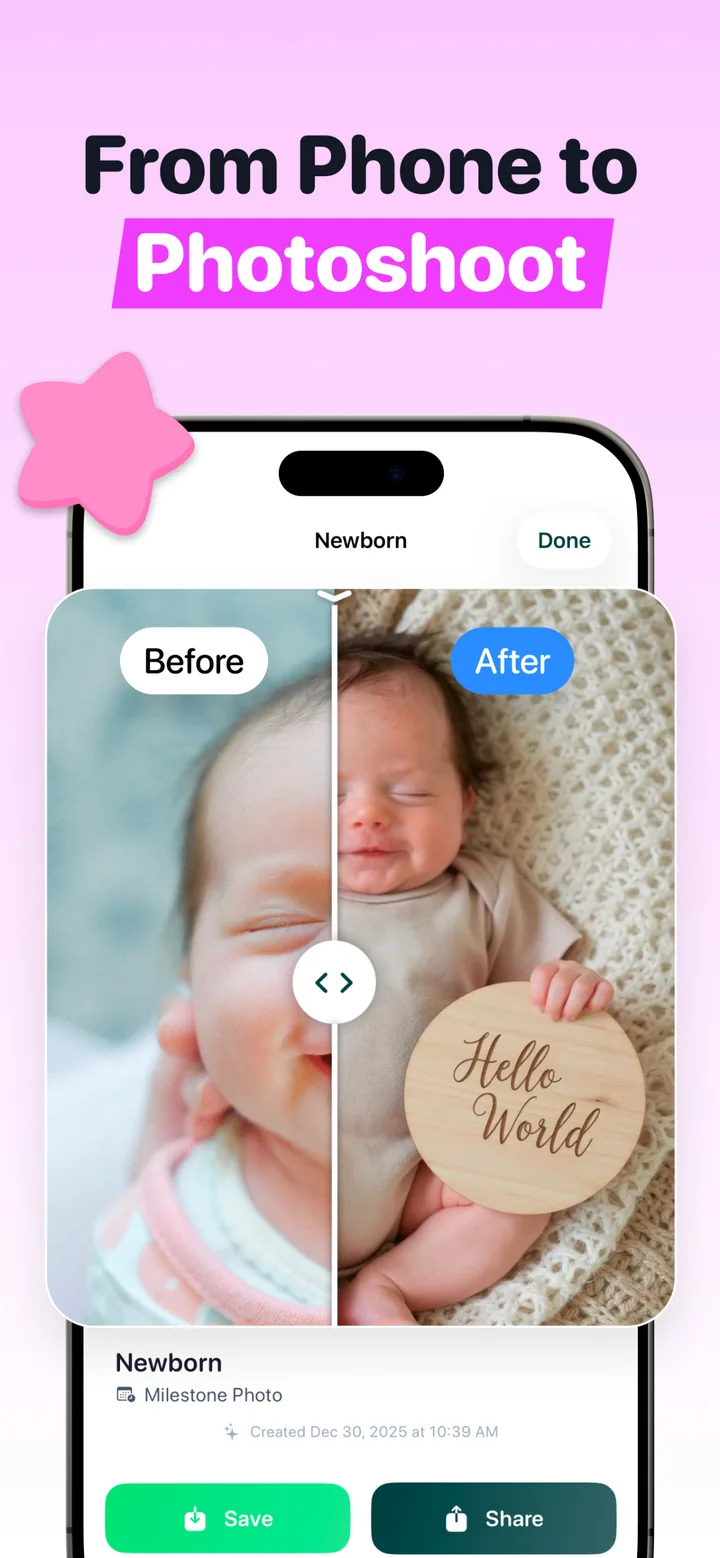
- Compare and export. A built-in before/after slider shows the original next to the portrait, and you can export in HD at 2048×2560, sharp enough for prints and framed wall art.
The workflow exposes its own quality-control point. Totti keeps the source and generated portrait together in a draggable comparison before frame selection and export. Check face shape and expression first, then fingers, clothing edges and the direction of the new light. If one of those checks fails, return to source selection or try another template; a decorative frame should come only after the portrait passes review.
Do AI newborn photos look real?
When the source photo is sharp and the generation works well, the portrait can look convincing. The honest test is not a promise in a feature list; it is the before-and-after comparison. Check whether the face is recognizable, whether fingers and clothing edges make sense, and whether the new light matches the scene. If a result looks wrong, discard it and try a clearer source or another template.
The source photo supplies the real baby. The AI supplies the set design. The before-and-after view tells you whether the two still belong together.
| Element | What happens in the AI photoshoot |
|---|---|
| Face & features | Designed to remain recognizable; compare closely with the source |
| Background | Replaced with the template scene (studio, garden, holiday set) |
| Lighting | Regraded to soft, even studio light |
| Outfit | Swapped for a virtual outfit matched to the scene |
| Pose & props | Staged to match the template; no physical posing needed |

Try an AI newborn photoshoot free
Totti is free to download for iPhone and requires iOS 17+. Upload one snapshot, pick from 50+ templates, check the before/after slider, and export your favorite in HD 2048×2560.
Get Totti on the App StoreWhat an AI newborn photoshoot can't do
- It can't fix an unusable source photo. If the face is heavily blurred, in deep shadow or mostly covered, the AI has too little source detail. A sharp, front-lit photo is the best starting point; our guide shows how to take that photo at home.
- It works best with one baby per portrait. The portrait templates are designed around a single star of the show.
- It won't replace candid family moments. Keep taking the messy, real-life photos too. Dad asleep on the couch with the baby is a memory no template covers.
- It's a portrait tool, not a keepsake of an experience. If the studio day itself matters to you, AI complements it rather than replaces it.
Parents also reasonably ask about privacy and whether uploading baby photos is wise at all, so we've written a straightforward take on whether AI baby photography is safe.
Getting the best result from your upload
The AI is only as good as the photo you hand it, though the bar sits lower than most parents expect. One sharp frame beats a hundred mediocre ones. A few habits that consistently improve the output:
- Daylight over lamplight. Window light keeps newborn skin tones true, which helps the AI blend your baby cleanly into the new scene.
- Fill the frame with the face. Shoot from straight-on or slightly above, close enough that features are crisp.
- Skip filters on the source photo. Upload the unedited original, because beauty filters distort exactly the features you want preserved.
- Take a few options. Eyes-closed and eyes-open source photos give you two different moods of portrait from the same session.
Your first AI newborn photoshoot with Totti
- Download Totti free from the App Store and set up your baby's profile. The app tracks each baby's journey and photo history separately.
- Upload a clear snapshot with the face visible, in daylight if possible, straight-on or slightly above.
- Browse templates and pick a scene, maybe Sweet Slumber for a classic sleeper look, or a "Hello World" milestone card if you're announcing.
- Generate, then drag the before/after slider to compare against your original.
- Add a frame if you like (Polaroid, Vintage, Wood, Gold or Floral), then export in HD.
From there, the same portrait works everywhere, from birth announcements and holiday cards to the grandparents' group chat and the nursery wall. One snapshot in, a full photoshoot out. That's the whole idea.