Your baby is fed, changed, wide awake, and staring at the ceiling fan like it owes them money. You have the phone up. You make the noise that worked yesterday. Nothing. The fan is still winning.
Learning how to make a baby smile for photos is mostly about matching the trick to the age, then getting your own face out from behind the phone. Both parts are easy once someone tells you.
When do babies start smiling for real?
In the first weeks, those flickers of a grin are reflex smiles. They happen in light sleep, after a feed, during a satisfying stretch, and they have nothing to do with you or your excellent duck impression. Lovely to catch, impossible to prompt. Shoot the sleeping ones and take what the reflex gives you.
The real social smile, the one aimed at a face, usually arrives somewhere around six to eight weeks. Some babies are early, some take until ten weeks, and none of that predicts anything at all. From that point the tools change roughly every couple of months, as the timeline below sets out: two months brings the first true smiles, four brings head control and usable eye contact, six brings anticipation games, and by nine to twelve months you are dealing with a small person who has opinions about the camera.
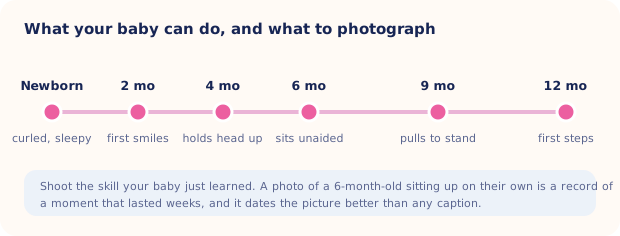
Which tricks work at which age?
The table below is the version worth keeping on your phone. Find your baby's current row, try the middle column first, and take the right-hand column seriously, because those are the moves that reliably produce a blank stare and a lost minute.
| Age | What earns a smile | What fails |
|---|---|---|
| 0–6 weeks | Nothing you do. Catch the sleep smiles | Any performance at all |
| 6–12 weeks | Your face close and exaggerated, slow and quiet | Loud noises, fast movement |
| 3–5 months | Silly sounds, raspberries, a familiar voice off to the side | Repeating the same trick twice |
| 6–9 months | Peekaboo, anticipation, a build-up and a pause | Handing them a toy (they look down, not up) |
| 9–12 months | Their own name, someone they love just off-camera | Asking them to say cheese |
How do you make a baby smile for photos?
- Your own face, oversized. Wide eyes, eyebrows up, mouth open. Babies read faces before anything else, and a big slow expression twelve to eighteen inches away beats every gadget.
- Peekaboo, with the pause. The laugh comes from the anticipation, not the reveal. Hide, wait one extra beat, then appear.
- A crinkly wrapper. A crisp packet or a sheet of tissue paper makes a sound no toy makes. Keep it out of frame and out of reach.
- Their own name. From about six months this pulls the head around faster than any noise, and it turns their expression into recognition rather than surprise.
- Someone they love, just off-camera. A partner standing at your shoulder gets the eyeline almost in the lens, which reads as warm rather than posed.
- A small surprise. A gentle blow on the tummy, then pull back and shoot. The smile lands about half a second after you retreat.
Rotate them. A trick that works brilliantly at 10am has usually been solved and filed by 10:04, and repeating it just gets you a polite stare.
The phone in front of your face is the problem
Babies smile at faces. If your face is behind a phone, there is no face, which is why so many attempts produce a baby looking somewhere slightly to the left of the frame with a neutral expression. Three fixes, in order of how well they work:
- Bring in a second person. They stand directly behind your shoulder and do the performing while you shoot. Best results by a wide margin.
- Hold the phone beside your head, not in front of it. Arm out, phone level with your ear, your whole face visible. The eyeline lands close enough to the lens to read as eye contact.
- Shoot without looking. Frame loosely, keep your eyes on the baby rather than the screen, and press the volume button. Wide framing plus a later crop beats a perfectly composed photo of a distracted baby.
Use the rear camera rather than the selfie camera when you can. It is the better lens on every phone (by a wide margin on recent ones), and the extra sharpness matters if you plan to print. Our iPhone newborn photo guide covers focus and exposure locking, which pairs well with shooting one-handed.
Timing beats technique
An unhappy baby cannot be talked into a good photo, and a hungry one certainly cannot. The window is roughly twenty to forty minutes after a feed, after a nap rather than before, with a fresh diaper and a warm room.
- Late morning is the reliable slot for most babies, who by then are fed, rested, and still ahead of the afternoon fussiness.
- Never right before a nap. Tired babies look tired in photographs, and no trick outruns it.
- Ten minutes, maximum. Set up first, get the light right, then bring the baby in. See the best time of day for baby photos for how the light and the schedule line up.
Shoot the second after the laugh
At the peak of a laugh, most babies are mid-blink with a wide open mouth and a scrunched face. It looks great in real life and slightly alarming in a still frame. The frame worth having is the settle right after, with the eyes open again, the mouth still curved and the cheeks up.
So keep shooting for two full seconds past the joke. Burst mode does this for you if you hold the shutter, and it costs nothing but storage. Then delete ruthlessly the same evening, before the good frames get buried under the forty near-misses.
A baby will smile at a face long before it smiles at a lens. Give them a face to smile at and put the camera somewhere beside it.
How do you know when to stop?
Babies signal overstimulation clearly once you know the tells: turning the head away, a glazed stare past you, arching the back, jerky arms, sudden hiccupy fussing. That is not stubbornness, it is a small nervous system saying it has had enough input for now.
Stop before the meltdown rather than during it. One genuine smile in a five-minute session is a good session, and the sleepy calm frames that come afterwards are often the ones you keep. On days when nobody feels like performing, fall back on the documentary approach. Put the camera down, wait, and photograph whatever happens.

Got the smile, but the room was a mess?
Upload the frame where the face is sharp and Totti regenerates the background, lighting and styling around it while aiming to keep your baby recognizable. Review the result against the source. 50+ templates, milestone cards for weekly and monthly updates, and HD export at 2048×2560. Free to download on iPhone.
Get Totti on the App StoreThe trick that finally works will be something ridiculous and specific to your baby. A cough. A particular squeak. The dog. When you find it, write it in your notes app, because you will forget it by next month and by then it will have stopped working anyway.