The first one is usually taken through plastic. A phone tilted to dodge the glare off the isolette, a small face half-hidden by tape and tubing, one hand curled near the sensor on the wrist. Nobody pictures this photo in advance. Plenty of parents keep it closer than any of the ones they planned.
Premature baby photos follow different rules from the ones in ordinary newborn guides. The room belongs to the hospital, the schedule belongs to your baby, and the equipment is staying exactly where it is. This guide is written around all three, at whatever pace suits the week you are having.
What should you ask the NICU staff before taking photos?
Every unit sets its own policy, and they vary more than parents expect. Ask your baby's nurse at the start of a shift rather than mid-task, and ask again if you move to a different bay.
- Photos during procedures and rounds are often not allowed. A line placement, an intubation, a ward round with names read aloud are all usually a no.
- Other families are in the frame more often than you think. Check the background for other isolettes, name cards, charts and screens before you tap.
- Ask before including staff. Many nurses will happily be in a photo with the baby they have looked after for six weeks. Some would rather not, and both answers are fine.
- Never move anything yourself. Not a lead, not a line, not the cover over the isolette. If a wire is crossing the face, ask the nurse whether it can be tucked.
Can you use flash in the NICU?
Switch the flash off properly in your settings, not just to auto. It startles babies, disturbs the baby in the next bay, and preterm eyes are sensitive. If the bay is dim, ask whether the light above the bed can come up for a minute and accept a little grain. Grain ages beautifully. Flash does not.
Let night mode take its time, brace both elbows against something solid while it does, and take three or four in a row rather than one. If the plastic in front of the lens is smeared and the nurse says it is fine to touch, a clean cloth removes more haze than any edit ever will.
The wires belong in the picture
Most parents' instinct is to hide the medical side. Wait for a tidier day, crop out the tape, angle away from the tube. That instinct is worth questioning, because the equipment is part of what your baby came through. The CPAP prongs date the picture better than any caption could.
You do not have to choose. Take one frame with everything visible and one close frame of a hand or an ear where nothing shows. Both are true, and choosing between them is a job for later. Nothing in a preemie photo needs correcting.
If you are unsure today, keep both. The frame you want in a year is often not the one you would choose this week.
Which small details are worth photographing?
The tight shots are the ones families reach for. They need almost no light, no cooperation, and about four seconds.
- Your whole finger inside their hand, their fingers barely closing around it
- A foot against your thumb
- The ear, which is somehow the detail parents miss most once it grows
- The name card on the isolette, with the date and the birth weight on it
- The first time you hold them, skin to skin. Ask a nurse to take it. They will say yes, and they are better at it than you would think
- First feed, first bath, first day in an open crib, first day without support
- A sibling's first visit, from behind, looking in
One more that almost nobody takes is a photo of you. In the chair, same clothes as yesterday, hand through the porthole at 3am. That is the record of what those weeks actually were.
How do you show how small your baby really was?
Get close to a very small baby and the picture flattens out. Without a reference, every baby looks roughly the same size on a phone screen. Put something familiar in the frame and the scale comes back:
- An adult hand resting flat beside them, or under them when a nurse is supporting
- A wedding ring laid next to a foot
- A diaper, unfolded, next to the one they are wearing
- A preemie hat beside a newborn-size hat
- The same soft toy in every photo, from week one to going home day. That is the one that will floor you at the end
What families say they are glad they photographed
| The photo | Why parents come back to it |
|---|---|
| The first hold | Often the first time the whole thing feels real |
| A wide shot of the bay | The room disappears from memory faster than the baby does |
| Hand or foot against an adult hand | The only reliable record of how small they actually were |
| The equipment, unhidden | Shows what they came through, without a word of explanation |
| The nurses | Names fade in a year. Faces do not |
| Going home day at the doors | The end of the chapter, in one frame |
Not every NICU stay follows the shape this guide assumes. If your baby is very sick, the photos you have are not too few and they are not the wrong ones. Ask the unit's social worker what photography support the hospital can arrange. It is an ordinary question, staff have heard it many times, and asking early is easier than asking late.
The days you leave the phone in your pocket
You are not obliged to document any of this. Some days you will sit and hold a hand for two hours and take nothing, and that is a complete visit. Rough days, procedure days, the day a number goes the wrong way. Put the phone away. There is no photo you owe anyone.
A week with nothing on the camera roll is not a gap you have to make up afterwards. And if there is one particular photo you know you would want, a first hold, a hand closed around your finger, a nurse can usually take it in thirty seconds on a calmer day. Ask then, and let the week be what it needs to be.
Going home day
It arrives suddenly and then takes six hours of paperwork (the six hours are not a joke). A short list, so you are not thinking about it while it happens:
- The empty isolette or crib, made up, before you leave the bay.
- Your baby in the car seat, indoors, before the doors.
- The staff on shift, if they are willing. Ask early in the day.
- Someone else photographing you carrying the seat out through the doors.
- The front door of your house from the inside, as you come through it.
Some units make a sign with the discharge date on it. If yours does, photograph it flat and straight on as well as held, because flat is the version that prints well, as our guide to printing baby photos explains.
What about premature baby photos once you are home?
Home photos can wait until everyone has slept, which may be a while. Before changing position or building any setup after discharge, ask the hospital team or your baby's pediatric clinician what is appropriate for your child. If they approve a short floor-level photo, keep the starting setup firm, flat and back-lying, with an adult beside the baby. Between frames, use the sleep setup your care team recommends; the American Academy of Pediatrics describes the general recommendation as a firm, flat surface on the back with nothing loose near the face. The diagram labels photo complexity and supervision; it does not replace individualized medical advice.
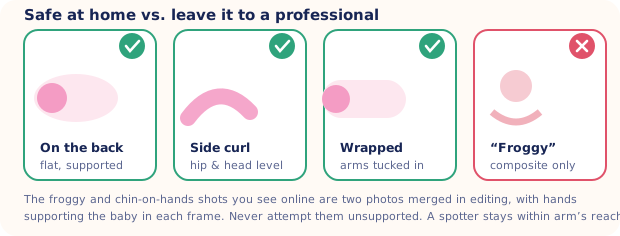
Use window light, keep the flash off out of habit now, and read our newborn photography safety notes before trying anything from Instagram. The propped and suspended poses are always two photos merged in editing, as our newborn photo poses guide explains.
Milestone photos are their own small question, because your baby may have two ages and neither one is wrong. Some families count from the due date, some from the birthday, and some drop ages entirely and photograph what their baby can do instead, which our milestone photo guide covers. Pick whichever makes you feel calm.
A note for later, not for this week
Months from now, you may want something framed for a wall, and dim hospital shots are a solvable problem whenever you feel like solving it. Totti restyles a clear photo you already have, aiming to keep your baby recognizable while changing only the background, lighting and styling. It will still be there when the NICU is behind you.

For whenever you are ready
Totti turns one clear phone photo into a studio-style portrait or a milestone card, with the option to export in HD. Free to download on iPhone. No rush at all.
Get Totti on the App StoreBack up everything as you go, even the blurry ones. A shared album that grandparents can add to takes two minutes to set up, and our notes on organizing baby photos are a quiet-afternoon read.