You're running on two hours of sleep, the family group chat is vibrating, and everyone wants the picture. The best birth announcement photo ideas all protect three things: your baby's face stays clearly visible, the scene stays simple, and the layout leaves room for the details you want to share. One good frame is enough. A photographer is not required. Neither is leaving the couch.
This guide covers what makes an announcement photo work, which details fit comfortably in the layout, when to send it, print versus digital, and the fastest route from “blurry hospital snapshot” to a card-ready portrait. If you searched for birth announcement picture ideas, the same fifteen concepts apply; “photo” and “picture” describe the same intent here.
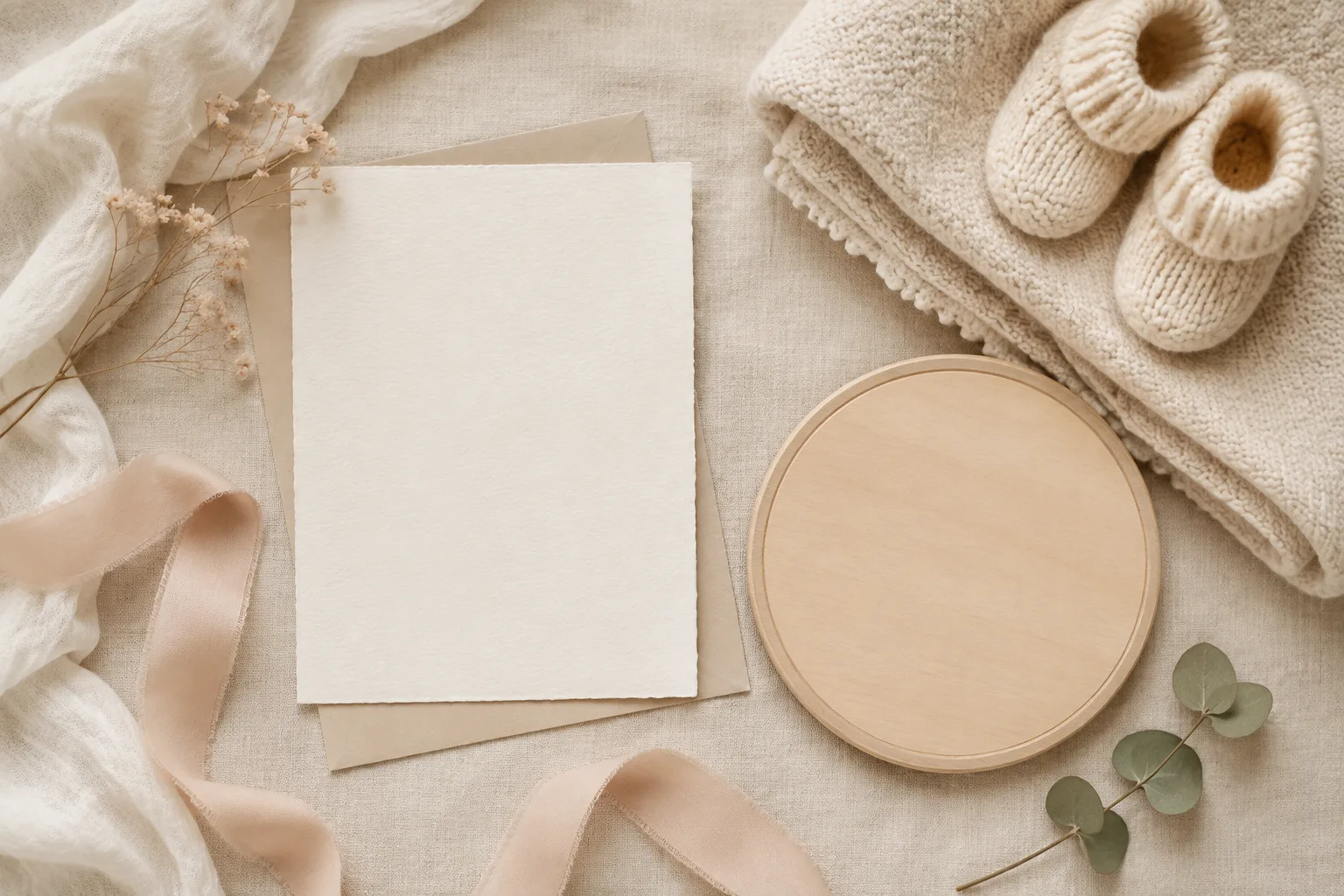
What makes a great birth announcement photo?
- The face is the photo. Fill the frame with your baby; announcements get viewed at phone-screen size, so tight and clear beats artistic and distant.
- Simple, uncluttered background. A plain blanket or wrap. Hospital-room clutter, laundry piles and busy prints all fight the star of the show.
- Soft, even light. Indirect window light flatters newborn skin; flash and overhead lights create harsh shadows and yellow tones.
- A comfortable baby. Awake or asleep can both work. Use the position your baby is already comfortable in rather than trying to create a curled pose.
- Space for text. If you'll overlay the name and stats, leave some quiet space in the frame, or use a milestone-card layout that builds the text in.
Which details belong in a birth announcement layout?
A photo card needs only the details you choose to place visually. Keep the text subordinate to the portrait and use this order when space allows:
- Full name. The headline. Middle name included if you're proud of it (you are).
- Birth date. Plus the time, if you like the detail.
- Weight and length. The stats grandparents quote for years.
- A short line from you. "We're so in love" does more than a paragraph on the image. Use our short baby announcement captions for a one-line finish, or the separate birth announcement wording examples when you need a complete text, email, card or social message. These "Hello World" sign ideas show how to work the essentials into the photo itself.
Two extras are worth a thought. If the name has a pronunciation nobody will guess, a short phonetic line saves you twenty replies asking. And naming older siblings ("joins big sister Noor") matters far more to them later than it does to anyone else now.
Five birth announcement layouts, with practical canvas sizes
Choose the destination before you crop the photo. Useful starter canvases are 1600 × 1200 px for a private 4:3 message, 1080 × 1350 px for a portrait feed, 1080 × 1920 px for a vertical story or status, and 1080 × 1080 px for a square detail grid. For a 5 × 7-inch printed card, start at 1500 × 2100 px at 300 ppi before any bleed required by the printer.
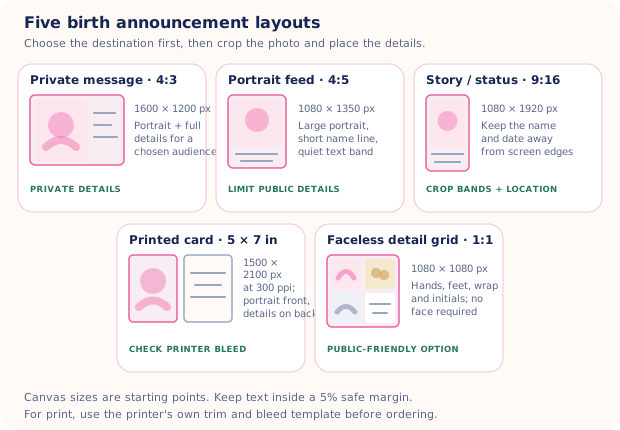
Download the birth announcement layout guide (SVG). The vector file stays sharp if you enlarge it for a planning sheet or class handout.
| Layout | Build | Privacy choice |
|---|---|---|
| Private 4:3 message | Portrait on roughly two-thirds of the canvas; name and details in the remaining space | Include full birth details only when you have deliberately chosen every recipient |
| Portrait feed | Large portrait with one quiet text band below it | For a public post, consider first name or initials and omit exact time, hospital and location |
| Vertical story or status | Keep the face and text away from the outer 5% so interface controls do not cover them | Crop wristbands, paperwork, room boards and address labels before placing the photo |
| Printed 5 × 7 card | Use the portrait alone on the front and put the longer message and stats on the back | Confirm the trim and bleed template with the printer before ordering |
| Faceless square grid | Combine four close crops: hands, feet, wrap texture and a name plaque or initials | Share the family connection without showing the baby's face or exact birth details |
Canvas size does not guarantee the final crop: messaging apps and social platforms may resize or recompress the file, so keep the original export. Privacy is also more than a face/no-face decision. Check the edges for identifiers and decide which details fit the audience; the baby photo sharing guide gives a practical audience-by-audience check.
15 birth announcement photo ideas that work
Simple one-photo announcements
- The sleeping close-up. Place baby on a plain blanket, stay within arm's reach, and shoot from directly above with the face filling the frame. This is the dependable option when the announcement will be viewed mostly on phones.
- The “Hello World” card. Put a plaque or printed card beside the baby, never propped on them. The words become part of the photo, so you can send the finished frame without designing a separate layout.
- The negative-space portrait. Position the baby on the left or right third of the frame and leave clean blanket space beside them. That quiet area gives a card designer room for a name and birth details without covering the face.
- The hand-and-face crop. Frame the baby's face beside a parent's hand. The hand adds scale, warmth and connection while keeping the composition simple enough for text.
- The black-and-white portrait. A monochrome edit helps when the hospital or bedroom contains several clashing colors. Keep contrast gentle so skin and blanket texture do not disappear into pure white or black.
Photos that tell more of the family story
- The parents' hands cradle. Two sets of hands around a safely supported baby create a family picture without asking sleep-deprived parents to be camera-ready. Have another adult take the frame; never balance the phone above the baby.
- The sibling introduction. Seat the older child beside a baby who is lying safely on a firm surface, with an adult close enough to intervene. A hand on the blanket, a look toward the baby or a shared name card usually works better than asking for a perfect cuddle.
- The homecoming frame. Photograph baby in a caregiver's arms near the nursery doorway or front window. It says “we are home” without revealing an address, hospital band or other personal detail.
- The meaningful-heirloom detail. Place a family blanket, book or small keepsake near the edge of the setup, safely out of the baby's reach. One object is a story; five objects become clutter.
- The matching parent-and-baby detail. Photograph two hands, matching bracelets or a close crop of parent and baby profiles. This works well for families who want the connection without showing every face publicly.
Collages, cards and themed layouts
- The detail trio. Pair one clear face portrait with tiny feet and curled fingers. Keep the face frame largest so the collage still reads instantly at message-preview size.
- The hospital-to-home pair. Put the first hospital snapshot beside a calmer portrait from home. Crop visible paperwork, wristband numbers, room boards and location clues before sharing.
- The seasonal accent. Add one seasonal color or small motif rather than building a crowded set. A warm knit for autumn or a single spring bloom keeps the baby, not the holiday, at the center.
- The photo-strip story. Use three frames in sequence: eyes closed, one yawn, one hand detail. Leave a plain band at the bottom for the name and date.
- The printed front-and-back card. Put the strongest portrait alone on the front, then move the birth details and a second candid to the back. The face gets room to breathe, and no text has to sit over the photograph.
The name itself can shape the layout too. Our baby name announcement quotes include short lines designed for plaques, negative space and photo cards.
When should you send birth announcement photos?
There's no rule. There's only your energy level. A private digital note can go out whenever you are ready, while printed cards can wait until everyone has settled in and you have a photo you love. Some studios prefer to schedule early for a particular sleepy aesthetic, but a meaningful announcement photo has no expiration date. Our post on when to take newborn photos explains the options without treating one period as a deadline.
If printed cards need to land by a particular date, work backwards from it rather than forwards from today. Printers count turnaround from the moment you approve the proof, not from the moment you upload, and the proof round trip is where the extra days go.
Nobody remembers whether your announcement arrived in week one or week six. They remember the photo. Optimize for one great picture, not for speed.
Print vs. digital announcements
The two formats fail differently. A slightly soft shot still passes on a phone screen. The same file on a 5×7 card comes back visibly fuzzy, and nothing can be done once the box arrives.
| Digital (text/social) | Printed card | |
|---|---|---|
| Speed | Can be shared as soon as you are ready | Requires proof approval, printing and delivery |
| Cost | No printing or postage | Varies by printer, paper, quantity and postage |
| Reach | Everyone, instantly | The mantel-and-fridge crowd |
| Keepsake value | Scrolls away | Kept for decades |
| Photo requirement | Any decent shot | Sharp, high-resolution portrait |
| Privacy control | Depends on the audience and platform | Sent directly to a chosen address list |
Most families do both, a fast digital share now and printed cards later. Which means the photo needs to survive both a phone screen and a 5×7 print. That's where resolution and clean styling start to matter.
How do you get birth announcement photos without a photographer?
The week you need this photo is the week you're least equipped to stage a photoshoot. An AI scene can handle the studio work after you take the picture. Pick one clear snapshot already on your phone, and Totti is designed to rebuild the backdrop, lighting, wardrobe and styling while retaining your baby's recognizable features. Use the before-and-after view to check the result against the source before you share it.
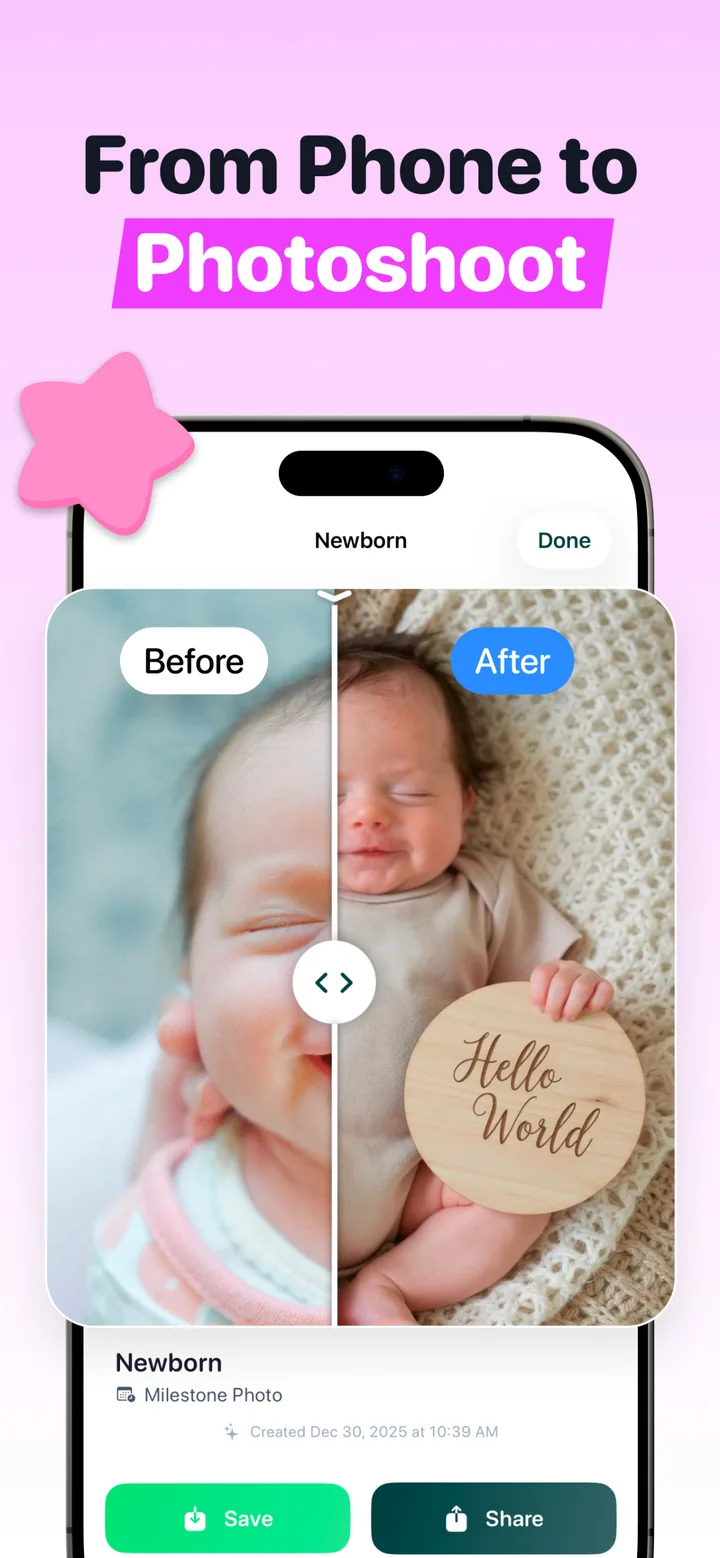
The "Hello World" milestone card is practically purpose-built for announcements. Your baby is styled on a soft knit blanket with an elegant wooden plaque, in a layout that already says "announcement" before you add a single word. From there, export in HD at 2048×2560, which is more than enough resolution for standard announcement cards, and share the original-vs-portrait comparison if you want to blow up the group chat twice.

Announcement-ready in minutes
Upload one snapshot, choose the "Hello World" milestone style, and export a studio-style announcement portrait in HD (2048×2560), from the hospital bed or your couch. Free to download on iPhone.
Get Totti on the App StoreQuick checklist before you hit send
- Name spelled correctly: check it twice, then have someone else check it.
- Date, weight and length accurate (the hospital paperwork is your source of truth).
- Photo sharp at full size; zoom in on the face before printing.
- Everyone who should hear it personally has heard it before the public post.
- Hospital bands, paperwork, room numbers, addresses and location clues are cropped out.
- The sharing audience matches the details included; a private card can carry more than a public post.
For a nicer source photo than the ones currently on your phone, a short window-light session may be all it takes. Our newborn photoshoot at home guide walks through the setup with a blanket and a phone. If you need a complete message rather than a one-line caption, use these birth announcement wording examples for texts, cards, email and social posts.