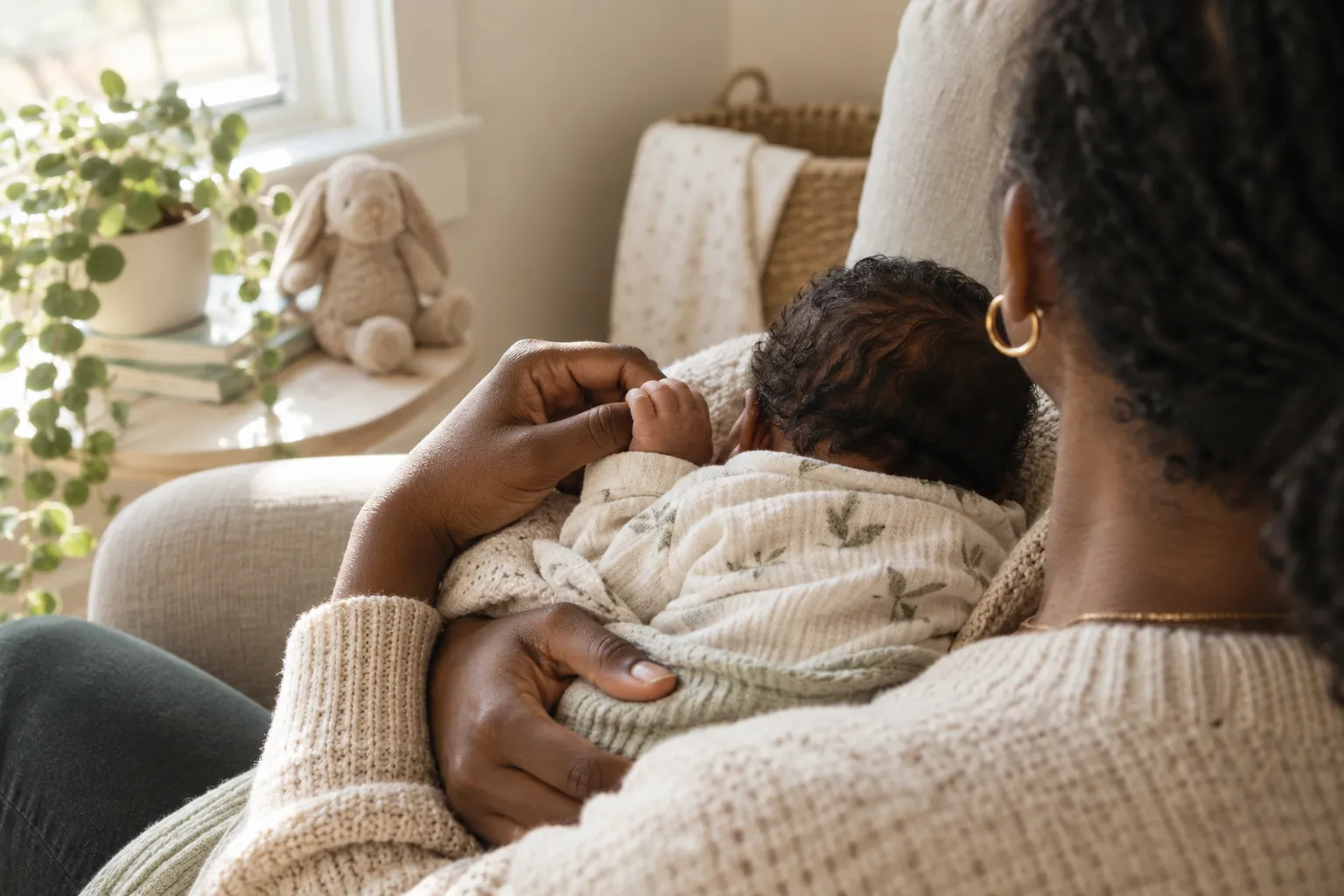
The best faceless baby photo ideas photograph connection and scale instead of identity: a tiny hand around one finger, feet against a parent's palm, the crown of baby's head over a shoulder, or a silhouette beside a window. Keep baby in a natural, supported position and change the camera angle rather than turning or covering the face.
One important limit comes first: hiding a face does not make a photo anonymous. A name plaque, hospital bracelet, house number, distinctive nursery, location tag or captioned routine can identify a child without a face. Treat faceless composition as one privacy layer, then use the six-detail check below before sharing.
25 faceless baby photo ideas that still tell a story
Start with the details already in front of you. There is no need to arrange a newborn into a complicated pose, and nothing needs to be placed over the nose or mouth.
Tiny-detail photographs
- Hand around a parent's finger. Photograph from directly above and include enough of the adult hand to show scale.
- Both feet in one palm. Let the feet rest naturally; move your camera until the toes fill the frame.
- Fingertips on a blanket. Side light reveals the lines and soft folds without needing any styling.
- The crown and hair swirl. Shoot from behind the head while baby lies safely on their back with an adult beside them.
- One ear and a curl. A close crop can record a detail parents notice daily but rarely photograph.
- Wrinkled knees and toes. Include the texture of a plain onesie or blanket, but never force the legs into a curl.
- Parent and baby bracelets. Use an adult's ordinary bracelet; remove any hospital band that displays names or numbers.
Connection without a face-on portrait
- Over a parent's shoulder. Frame the back of baby's head and the parent's arms. Keep one hand supporting the head and neck.
- Chest-to-chest from behind. Photograph the adult's shoulder line, baby's crown and the supporting hands, never an unsupported upright baby.
- Forehead just outside the frame. Crop at the hairline and make the adult hands the center of the image.
- A sibling touching baby's foot. An adult stays in control of the setup while the older child gently reaches in.
- Three generations of hands. Layer a grandparent's, parent's and baby's hands for a simple generational portrait.
- Walking with the stroller from behind. Keep the canopy, street signs and recognizable home exterior out of frame.
- Parent reading beside the bassinet. Photograph from the baby's foot end; use the scene only while an adult is actively present.
Graphic, seasonal and storytelling frames
- Window silhouette. Expose for the bright window so the adult and baby become a dark outline, with the head fully supported.
- Shadow on a plain wall. Let late-afternoon light draw the shape of an adult holding baby, keeping identifying room details outside the crop.
- Swaddled from the shoulders down. Photograph the wrap, hands and feet; keep every layer below the chin and away from the airway.
- Seasonal socks. One pair of festive socks supplies the theme without a face, sign or large prop display.
- First outfit laid beside baby. Photograph the garment next to a safely back-lying baby, not draped over them.
- Milestone number made from blocks. Place the number well beyond reach and crop out any block letters that spell a full name.
- Favorite book and tiny hand. Put the closed book beside the hand, never propped above baby.
- Blanket texture from above. Use folds and negative space as the design while baby remains on a firm, floor-level setup.
- Footprints beside real feet. Pair a keepsake hospital footprint card with the feet, after covering names and record numbers.
- Parent's-eye view. Photograph the top of baby's head and your own knees while seated securely, with another adult taking the picture.
- One photo a month, same crop. Repeat a hands-or-feet composition to create a private monthly baby picture series that shows growth.
A faceless picture can protect one biometric clue. Privacy comes from removing the other clues and choosing a small audience, not from the camera angle alone.
The six-detail privacy check before you share
The Australian Government's eSafety Commissioner advises families to check photos for identifying details, including names, uniforms, home features, routines and location information. Use this original FRAME check on the image, caption and file:
| FRAME check | Look for | Safer edit |
|---|---|---|
| F — Face and features | Face, distinctive birthmarks, hospital bands | Change the angle; crop private medical details |
| R — Routine | Regular nursery, class or appointment times in the caption | Describe the moment without publishing a schedule |
| A — Address clues | Door numbers, street signs, window views, delivery labels | Crop tighter or use a plain indoor background |
| M — Metadata | GPS coordinates in an original file | Remove location before sending or upload through a trusted private album |
| E — Explicit identity | Full name, exact birthday, school or hospital | Use an initial or no text, especially for a public post |
| Audience | Public followers you cannot name | Send to a named group or password-protected album |
The last row matters most. A private message can still be copied, but a small named audience is easier to reason about than a public feed. Our complete guide to sharing baby photos without oversharing explains metadata, shared albums and how to agree reposting rules with relatives.
How do you compose a faceless baby photo?
Decide what the picture is about before pressing the shutter. If the answer is size, compare baby's hand with an adult finger. If it is connection, include supporting arms. If it is a season, use color and one small wardrobe detail instead of a sign full of personal information.
- Move yourself, not baby. Start with baby safely on their back or supported in a caregiver's arms. Step sideways, higher or closer to hide the face naturally.
- Use soft side light. Place the setup near a bright window without direct sun. The window-light guide shows the simplest angle.
- Focus on the story detail. Tap or focus on the fingers, toes, hair or supporting hands rather than letting the camera choose the blanket.
- Leave space on purpose. Negative space makes a small detail feel deliberate and leaves room for private album text later.
- Take a wider safety frame first. Confirm the full setup is stable, then crop in-camera or afterward. Never lean over baby from a chair.
Safety rules still apply when the face is hidden
A privacy goal never justifies covering baby's face, balancing a prop overhead or placing a newborn unsupported. Use only natural positions described in our safe newborn photo poses guide. If baby falls asleep during a temporary photo setup, return them afterward to the firm, flat, back-lying sleep space recommended by the American Academy of Pediatrics.
Silhouettes and crops are camera techniques, not physical poses. A parent's shoulder can block the view while both hands support baby. A close-up can exclude the face while baby remains comfortable. Stop when baby needs care; there is no photograph worth delaying feeding, sleep or comfort.
Can AI make a baby photo private?
No. An AI style change is not an anonymity guarantee, and a generated portrait should be treated as a baby photo when deciding where to share it. Totti restyles one existing baby photo into a new scene; it is designed for portraits, not identity removal. Review any result closely and run it through the same FRAME check before posting.

Create first, choose the audience second
If you want a styled portrait for your private family album, Totti can restyle one clear baby photo with a selected template. Compare the output with the original, keep only a result you like, and share it using the same privacy rules as any other image.
Get Totti on the App StoreChoose the shot, then choose its boundary
A hand, silhouette or over-the-shoulder frame can be more emotional than a face-on portrait because it records relationship and scale. Make that creative choice first. Then remove names, routines, location clues and metadata, and decide who actually needs to see it.
Keep face-on portraits too, even if they never leave your camera roll. Organize them in a private album, print favorites using the baby photo printing guide, and let public sharing remain a small, intentional subset of the memories you make.