A one-month baby photoshoot does not need a tiny cake, a costume or a baby who sleeps on cue. At this age, the story is in the ordinary changes: more alert eyes, a fuller cheek, a hand opening for a second and the way your baby fits against your chest.
Plan for ten calm minutes in a bright room. Make pictures on a clear floor or in a secure adult hold, and stop when your baby turns away, fusses or needs care. The goal is a record of this month—not a list every family must complete.
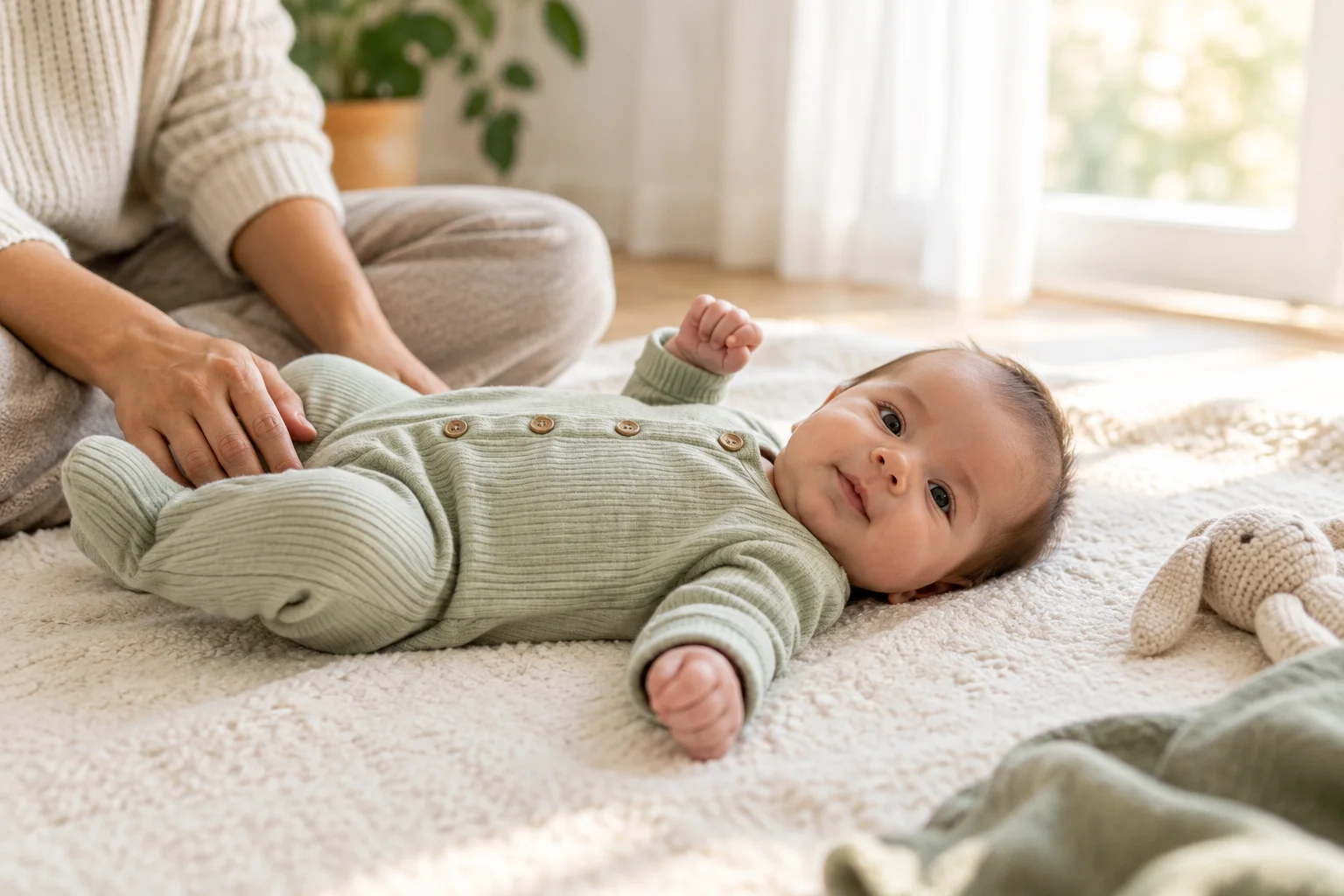
Start with the baby you have today
One month is an age label, not a posing milestone. Keep every setup flat and supported. Photograph your baby awake on their back on a clear floor mat, or held by a seated adult with the head and neck continuously supported. Do not try chin-on-hands, suspended, upright or container poses at home; many polished newborn portraits use trained hands and composites.
If your baby falls asleep, end the setup and move them to their normal safe sleep space. The American Academy of Pediatrics' safe-sleep guidance recommends a firm, flat infant sleep surface, with baby on their back and no loose objects. A decorative photo blanket or adult bed is not a sleep space.
18 first-month photo ideas
1. The awake floor portrait
Place a firm mat a few feet from a window, keep a parent beside it and photograph from baby's eye level. Leave generous space around the face and hands.
2. A true size comparison
Photograph the baby beside a parent's forearm or hand, without placing a small object near them. Repeat the same frame at three and six months.
3. The one-month card in the background
Stand a large paper card beyond reach and frame it softly behind the baby. Skip blocks, beads, confetti and loose letters.
4. Wide room, tiny baby
Include part of the nursery or living room. The room will change too, and this frame gives the close portraits context.
5. Window-side profile
Turn the mat so light crosses the baby's face. Move yourself—not the baby—until the eyelashes and cheek catch the light.
6. Parent-lap eye contact
Seat the adult sideways to the window, support the baby's head and wait for a brief glance. Keep the supporting hand visible.
7. The chest cuddle
A seated parent holds the baby against their chest while another adult photographs from the side. One wider frame and one hand detail are enough.
8. Feeding aftermath
Photograph the milk-drunk expression or the quiet burp-cloth moment once feeding is finished. Never interrupt a feed for a pose.
9. Hands opening
Use the regular 1× camera and move close when a fist relaxes. Do not unfold fingers or add rings and bracelets.
10. Toes and ankle folds
Frame feet against a plain onesie or blanket. This tiny picture works well beside a full portrait in an album.
11. The favorite sleeper
Choose one comfortable, washed outfit with no large hood, rough trim or dangling decoration. Photograph it before it is outgrown.
12. Swaddle detail while held
If swaddling is part of your usual routine, photograph the wrapped baby in a secure adult hold. Keep fabric clear of the face and stop when the baby shows signs of rolling.
13. A yawn sequence
Use Live Photos or a short burst for the start, middle and finish. Keep the strongest single frame instead of filling the library with duplicates.
14. The serious stare
Not every first-month portrait needs a smile. A calm, direct look often becomes the photograph that feels most like this stage.
15. Parent hands, baby body
Frame the baby's whole body with a steadying adult hand visible at the side. The hand shows both scale and care.
16. Sibling looking in
Keep the baby held by an adult and invite the sibling to sit alongside. Avoid asking a young child to hold the baby for the picture; see our sibling newborn photo ideas for safer arrangements.
17. Then-and-now pair
Match the angle of one birth-week photograph without recreating a styled pose. Equal crops make the first month of change easy to see.
18. The ordinary ending
Finish with the parent picking the baby up. The cuddle, stretch or relieved expression often says more than the planned setup.
A ten-minute shot list
- Wide view of the room
- Eye-level awake portrait
- Window-side profile
- Hand close-up
- Foot close-up
- One-month marker in the background
- Secure parent-lap portrait
- Parent and baby looking at each other
- Favorite outfit detail
- Pick-up cuddle
Use this as a menu, not a quota. If you want a broader first-year rhythm, our baby milestone photo guide separates documentation from decoration, while monthly baby picture ideas helps keep one repeatable frame consistent.
Phone settings that matter more than props
- Clean the lens. A fingerprint produces gray haze around window highlights.
- Use indirect window light. Turn off mixed-color ceiling bulbs and avoid a shaft of direct sun.
- Stay at 1×. Move closer rather than using digital zoom.
- Tap the nearest eye. Lower exposure slightly if the lit cheek loses detail.
- Brace your elbows. One-month-old movement is small but low indoor light still causes blur.
- Keep the original. Edit a copy and retain the unaltered family record.
For a fuller capture workflow, read how to take newborn photos on iPhone and the newborn photography safety checklist.
Turn one safe source photo into a styled milestone portrait
Digital styling happens after the physical photo. It does not make an unsafe pose safe, and an AI result may change facial, clothing or anatomical details. Compare the output with the source at full size and reject anything that does not look right.

Before uploading a child's image, get permission from every relevant parent or legal guardian and check the provider's current storage, retention, model-training and deletion terms; our AI baby-photo privacy checklist explains what to look for.

Create a first-month keepsake from one clear photo
Choose an existing baby photo and explore milestone or studio-style templates in Totti. Free to download; optional in-app purchases. Always review the generated portrait before saving or sharing.
View Totti on the App Store