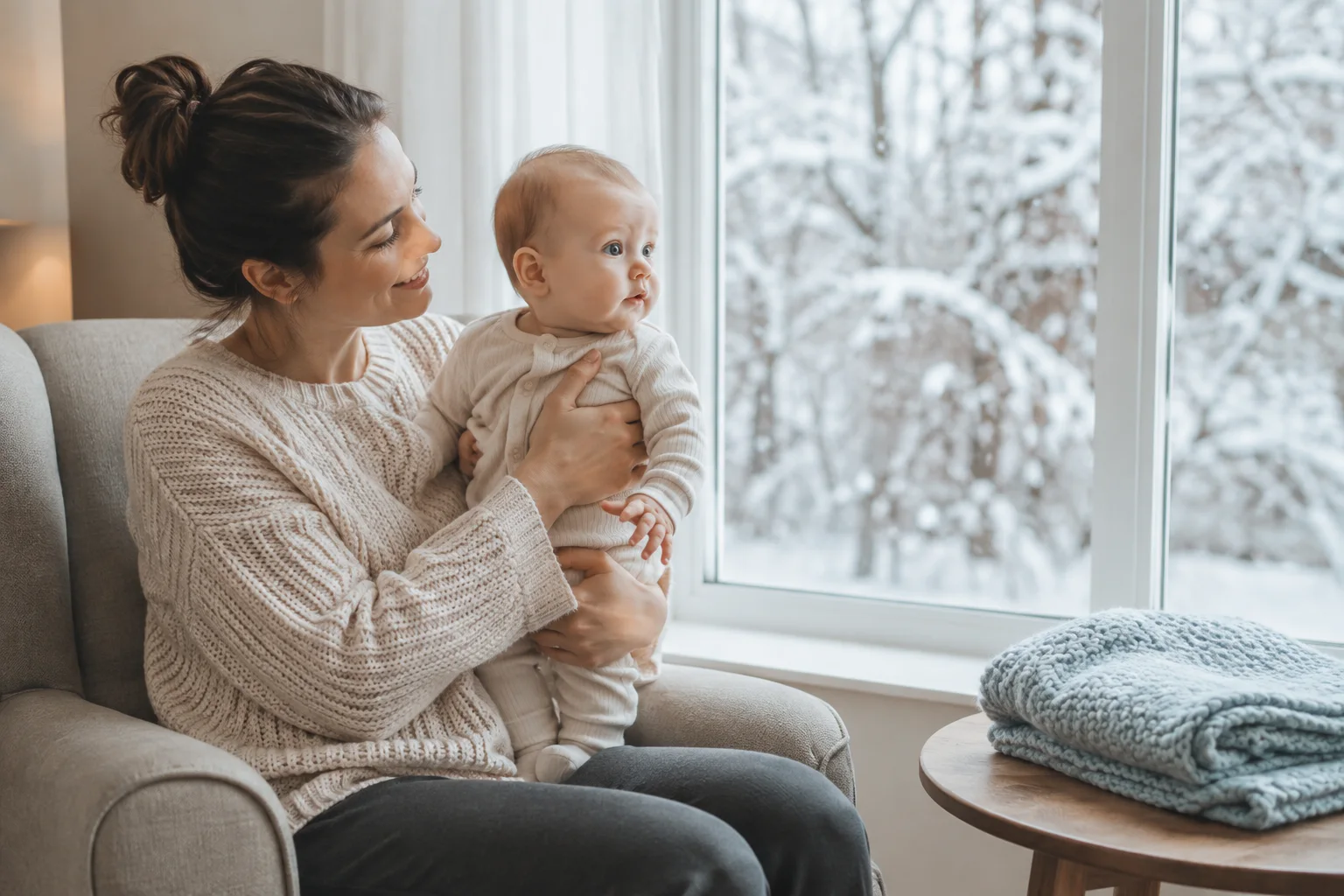
A convincing winter baby photoshoot needs cool seasonal context and a comfortably warm baby—not a complicated snowy set. Start indoors beside a bright window, dress the baby in their normal comfortable layers, and add one winter cue such as paper snowflakes secured to the wall, a cream knit worn by a parent, or a view of bare branches. Take six frames from one safe position before changing anything.
This page covers winter rather than Christmas. The palettes, weather stories and snow-inspired scenes work from the first cold week through late winter without trees, ornaments, Santa props or holiday-card wording. For that separate intent, use the Christmas baby photoshoot guide.
Choose a winter setup by age and weather
Use the least demanding row that tells the story. “Best position” means a position your baby already uses comfortably and ordinarily, not a milestone to introduce for the camera.
| Baby stage | Best position | Winter cue | Fast exit |
|---|---|---|---|
| Newborn or young infant | Ordinary supported adult hold, or awake on back on a firm floor-level setup | Parent’s knit, window view or paper shapes on wall | Remove the cue and continue the normal routine |
| Independent sitter | Level floor with an adult directly beside them | Cool palette and a secured backdrop | Parent moves into frame and holds baby |
| Crawler or walker | Normal play, supported stand or family walk | Window frost, boots or a snowy background | Follow the movement rather than resetting it |
| Any age, poor weather | Parent-held portrait indoors | Projected snow pattern or bare branches outside | Take a close crop with no props |
Eight indoor winter baby photoshoot ideas
- Window-and-knit portrait. Seat an adult at an angle to a large window and hold the baby in the usual supported position. A cream, slate or forest-green sweater supplies all the winter texture you need.
- Back-lying snow-wall setup. Secure large paper snowflakes to a wall, well above reach. While awake and supervised, place a young baby on their back on a firm, flat, floor-level setup and photograph from the side so the wall becomes the background.
- Bare-branch window frame. Hold the baby indoors with leafless trees visible through the window. Expose for the face and let the outdoor scene soften into cool lines.
- Footed-pajama details. Photograph toes inside a favorite footed sleeper, the zipper, a parent’s supporting hands and the expression above it. A four-image sequence often feels more wintry than a staged prop.
- Paper-snow shadow. Cut one snow shape from cardstock and place it near a lamp, far from the baby, to cast a soft pattern on a plain wall. Keep the light stable and cool to the touch; photograph the parent holding the baby in front of the pattern.
- Winter story time. A seated adult holds both baby and an illustrated winter book. Photograph the page color, the shared gaze and one close frame of adult and baby hands.
- Rainy or frosted glass reflection. Stand well inside with the baby securely held and photograph the reflection in a cold-weather window. Turn off nearby room lights if they create distracting double reflections.
- Morning layers sequence. Document a normal cardigan, socks and hat being added before a walk. Keep the series candid and stop before the room becomes a dressing set.
If your room is dim, move the setup closer to the window before adding equipment. The newborn window-light guide explains direction, distance and shadow checks without requiring direct flash.
Eight outdoor and doorway winter photo ideas
Check the forecast and wind, prepare the camera indoors, and treat the outdoor frame as optional. The American Academy of Pediatrics recommends warm layers for children in cold weather and notes that babies and children should wear thin, snug layers—not bulky coats or snowsuits—under a car-seat harness. Review its cold-weather safety guidance for your conditions.
- Open-door portrait. Keep the adult and baby just inside a bright doorway while snow, rain or bare trees appear outside. You get the weather context with a one-step return indoors.
- Parent-held snow background. On a calm, suitable day, stand on dry, level ground several steps in front of the snowy area. The adult remains fully visible as the secure support.
- Wrapped stroller walk. Photograph the ordinary buckling, canopy, adult hand and route of a real walk. Use the stroller as designed, keep it attended and do not park it on a slope for composition.
- Boot prints and a carried baby. One adult carries the baby while another photographs the adult’s footprints leading through fresh snow. The baby stays off the ground; the landscape tells the winter story.
- Snowfall at the window. When weather is wet, windy or uncomfortable, photograph from indoors as a parent holds the baby near glass. Falling flakes or rain remain visible beyond the face.
- Winter family walk. Photograph adults walking slowly toward the camera while one carries the baby securely. Choose cleared, non-icy ground and prioritize footing over the background.
- Stoop or porch greeting. Keep adults standing or seated in their ordinary safe positions and hold the baby. Use the door, exterior light and visible breath or soft sky as winter cues—no need to place the baby on a step.
- Sibling weather-watch. Photograph an older child looking through the window while a parent holds the baby beside them. Connection replaces the risky attempt to pose both children outdoors.
There is no universal photo-session duration or temperature that fits every baby, health history, wind level and set of clothing. Go inside whenever the baby or adult seems uncomfortable, clothing becomes damp, weather changes or the caregiver simply prefers to stop. A missed outdoor shot is easy to replace; comfort is the assignment.
Eight creative winter details for any home
- Cool-to-warm color story. Place a slate-blue background behind a parent in a warm oat sweater. The contrast reads as winter even when the weather outside is green.
- One snow globe—on a shelf. Put a snow globe on a stable surface behind the adult holding the baby, out of reach. Use portrait mode to turn it into soft sparkle rather than a handheld infant prop.
- Winter clothes flat lay. Photograph the hat, socks and cardigan without the baby, then pair that still life with a separate face portrait. The two-frame story is safer and clearer than surrounding the baby with clothing.
- First-winter card. Place a lightweight “first winter” card near an awake back-lying baby’s feet on a firm floor-level setup. Keep an adult beside the baby and remove the card as soon as the frame is complete.
- Blue-hour silhouette indoors. Before the room becomes dark, place the adult side-on to a window and expose for the faces. Keep the baby’s normal support visible rather than turning the hold into a silhouette puzzle.
- Hands warming after the walk. Back indoors, photograph adult hands removing mittens, touching baby’s clothed feet or holding a warm drink well away from the baby. The transition tells the season honestly.
- Same window, changing weather. Repeat one parent-held composition on a clear day, rainy day and snowy day. The position stays familiar while the world changes behind it.
- Beginning-and-end winter pair. Photograph the baby with the same adult, wall and crop at the season’s first cold spell and near spring. Use clothing color—not a forced pose—to connect the pair.
Winter belongs in the light, clothing and background. The baby never needs to become the prop that proves the season.
Which winter colors photograph well?
Begin with one cool neutral and one warm texture. Slate with oatmeal, icy blue with camel, forest green with cream, or charcoal with muted rose all feel seasonal without turning into a holiday palette. Avoid pure white across both clothing and background; a little tonal separation preserves the outline of the baby’s clothing and hands.
Choose fabrics by feel and fit before appearance. Scratchy knits, oversized hats and stiff costume layers become visible in a baby’s expression and need constant adjustment. Normal soft clothes plus one textured adult layer are enough. The newborn photoshoot outfit guide gives practical fit and coordination options.
Use one scene for a six-frame winter set
- Frame 1: wide view with the window or secured winter backdrop.
- Frame 2: vertical adult-and-baby portrait with full support visible.
- Frame 3: close face portrait turned toward soft light.
- Frame 4: hands, knit texture or footed-sleeper detail.
- Frame 5: a real interaction rather than everyone looking at the lens.
- Frame 6: horizontal composition with open space for a caption.
Change your distance instead of changing the baby’s position. If the baby falls asleep, end the styled setup and move them to an appropriate sleep space. The NIH Safe to Sleep program says an infant sleep area should be firm, flat and level, covered only by a fitted sheet, without loose blankets, pillows or toys. Read the safe sleep environment guidance; a cozy photograph is not a reason to leave winter textiles in a sleep space.
Can Totti create a winter-style baby portrait?
Totti can restyle one existing individual baby photograph using a themed photoshoot template. Start with a clear, well-lit face and ordinary comfortable position. Choose an available cozy, classic or seasonal look, then compare the generated portrait with the source before saving or sharing. Recognizability is a goal rather than a guarantee.
The app is useful when outdoor conditions do not suit a session or when you have one good snapshot but no winter background. It does not replace a real family walk, shared window moment or first reaction to snow. Keep those documentary frames real, and use Totti for a separate studio-style solo portrait. The AI newborn photoshoot guide explains how to choose the source image.

Create winter style without winter weather
Upload a clear individual baby photo, choose from 50+ photoshoot templates, compare the generated portrait with the source, and export at 2048×2560. Totti is free to download for iPhone and requires iOS 17.0 or later.
Get Totti on the App StoreComfort-first winter checklist
- Prepare the camera and backdrop before bringing the baby into the scene.
- Use a normal supported hold or an age-appropriate position baby already uses.
- Secure decorations to the background and keep small or loose items out of reach.
- Check the forecast, wind, surfaces and return path before an outdoor frame.
- Keep car-seat harnesses free of bulky coat material.
- Stop when anyone is uncomfortable; do not chase a fixed shot count.
- Move a sleeping infant from the photo setup to an appropriate sleep space.
Winter gives you strong light, texture and weather without asking the baby to perform. Pick one cue, take the safe frame first and let the season stay in the background where it belongs.